
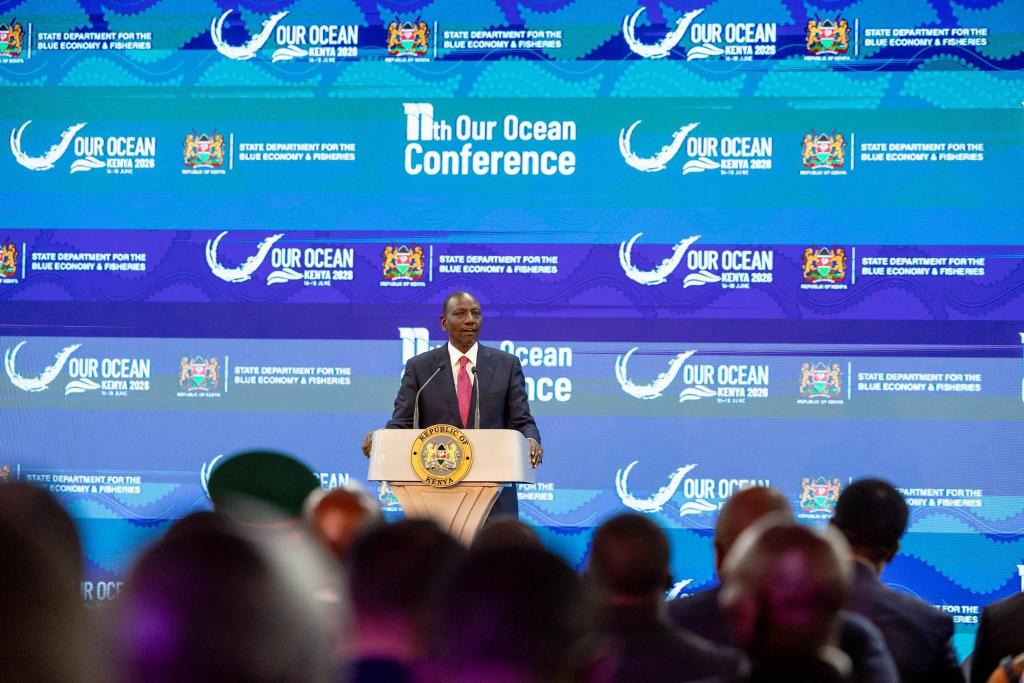
Kenya’s hosting of the Our Ocean Conference in Mombasa has placed illegal fishing under renewed global scrutiny, with countries backing a declaration aimed at exposing rogue vessels, tightening fisheries data-sharing and protecting coastal communities whose livelihoods depend on healthy oceans.
Sixteen countries have adopted the Mombasa Declaration in a fresh global push to combat illegal, unreported and unregulated fishing, a multi-billion-dollar criminal industry blamed for depleting fish stocks, weakening food security and hurting coastal communities.
The declaration was endorsed during the 11th Our Ocean Conference in Mombasa, the first edition of the global ocean summit to be held on African soil. The conference, held from June 16 to 18, brought together governments, scientists, civil society groups, investors and coastal communities under the theme, “Our Ocean, Our Heritage, Our Future.”
President William Ruto, in a virtual address to delegates, warned that oceans are under growing pressure from climate change, pollution, illegal fishing and biodiversity loss.
“The ocean powers industries and feeds families, but it faces a multiplicity of threats like global warming, plastic pollution, illegal fishing and the silent disappearance of life beneath the waves,” Ruto said.
He said Kenya was already taking action through mangrove restoration, cleaning up waters, fisheries reforms and stronger ocean governance.
“Kenya is already at work. We are restoring mangroves, cleaning our waters, reforming fisheries and strengthening ocean governance,” he said.
Ruto added that ocean protection must also create economic opportunities through blue finance, science and innovation, saying the moment had come to shift from sustainability to regeneration.
The countries listed as signatories to the Mombasa Declaration are Belgium, Cameroon, Chile, Republic of the Congo, Dominican Republic, France, Gabon, The Gambia, Ghana, Guinea, Liberia, Panama, Papua New Guinea, Peru, Somalia and South Korea.
The declaration commits governments to strengthen fisheries transparency by improving access to information on fishing vessels, ownership, licensing and fishing activity. It also calls for better data-sharing among states to help track vessels, expose illegal operators and support stronger enforcement at sea.
Illegal, unreported and unregulated fishing, commonly known as IUU fishing, is estimated to cost the global economy up to 50 billion US dollars annually. Experts warn that the practice distorts markets, undermines legal fishers, fuels declining fish stocks and is sometimes linked to unsafe working conditions and forced labour aboard vessels.
Ghana’s Minister of Fisheries and Aquaculture, Emelia Arthur, said the issue goes beyond enforcement and directly affects food security and national survival.
“In my country, our very existence depends on fish,” Arthur said, noting that more than 60 percent of Ghana’s animal protein comes from fish and that 10 percent of the country’s population depends on the fisheries value chain for livelihoods.
Arthur said the declaration gives governments a platform to work jointly in pushing for transparency in the fisheries sector.
France’s Minister Delegate for the Sea and Fisheries, Catherine Chabaud, said illegal fishing cannot be tackled effectively without stronger international cooperation.
“We will not be able to effectively combat illegal fishing without greater transparency and international cooperation,” Chabaud said.
The declaration builds on the Global Charter for Fisheries Transparency, which proposes 10 reforms including unique identification numbers for fishing vessels, publication of vessel licences and authorisations, disclosure of beneficial ownership, public vessel-position tracking, stronger seafood traceability and tougher action against flags of convenience.
Kenya’s Cabinet Secretary for Mining, Blue Economy and Maritime Affairs, Hassan Joho, told delegates that stronger global coordination is needed to confront illegal fishing. He called for a global blacklist of offending vessels, improved policy coordination and wider sharing of surveillance technologies.
Joho also said Kenya had increased its flagged fishing vessels from seven to more than 50 within a year, while negotiations were ongoing with the Indian Ocean Tuna Commission to raise Kenya’s tuna allocation beyond the current 3,200-tonne quota.
Conservation groups welcomed the declaration, saying it marks a major step in closing loopholes that allow illegal fishing vessels to operate across jurisdictions with limited scrutiny.
“For too long, illegal fishing has thrived in the dark,” said Tony Long, chief executive officer of Global Fishing Watch.
Oceana Vice President Beth Lowell said governments were now showing willingness to act against illegal fishing and build a more transparent and sustainable ocean economy.
The anticipated impact of the declaration is that rogue fishing vessels will find it harder to hide their identities, ownership and movements. With countries expected to publish vessel data, share surveillance information and tighten port controls, enforcement agencies could be better placed to detect suspicious fishing activity, deny illegal vessels access to ports and disrupt networks that profit from unreported catches.
For coastal communities, the declaration is expected to support fairer competition by protecting legitimate fishers from illegal operators who deplete stocks and distort seafood markets. Stronger transparency could also improve seafood traceability, making it easier for consumers, regulators and markets to know where fish comes from and whether it was legally caught.
For Kenya, the declaration places the country at the centre of a global conversation on ocean governance, maritime security and the blue economy. It also strengthens the country’s case for greater investment in fisheries surveillance, local fishing fleets, marine conservation and value addition in the blue economy.
The immediate test, however, will be implementation. Signatory countries are expected to begin putting the declaration into action, while more governments are being encouraged to join the initiative before the next Our Ocean Conference in 2027.
The success of the Mombasa Declaration will therefore depend not only on the number of countries that sign it, but on whether governments act on its commitments by publishing data, tracking vessels, exposing hidden owners and enforcing fisheries laws beyond conference halls.


Comments (0)